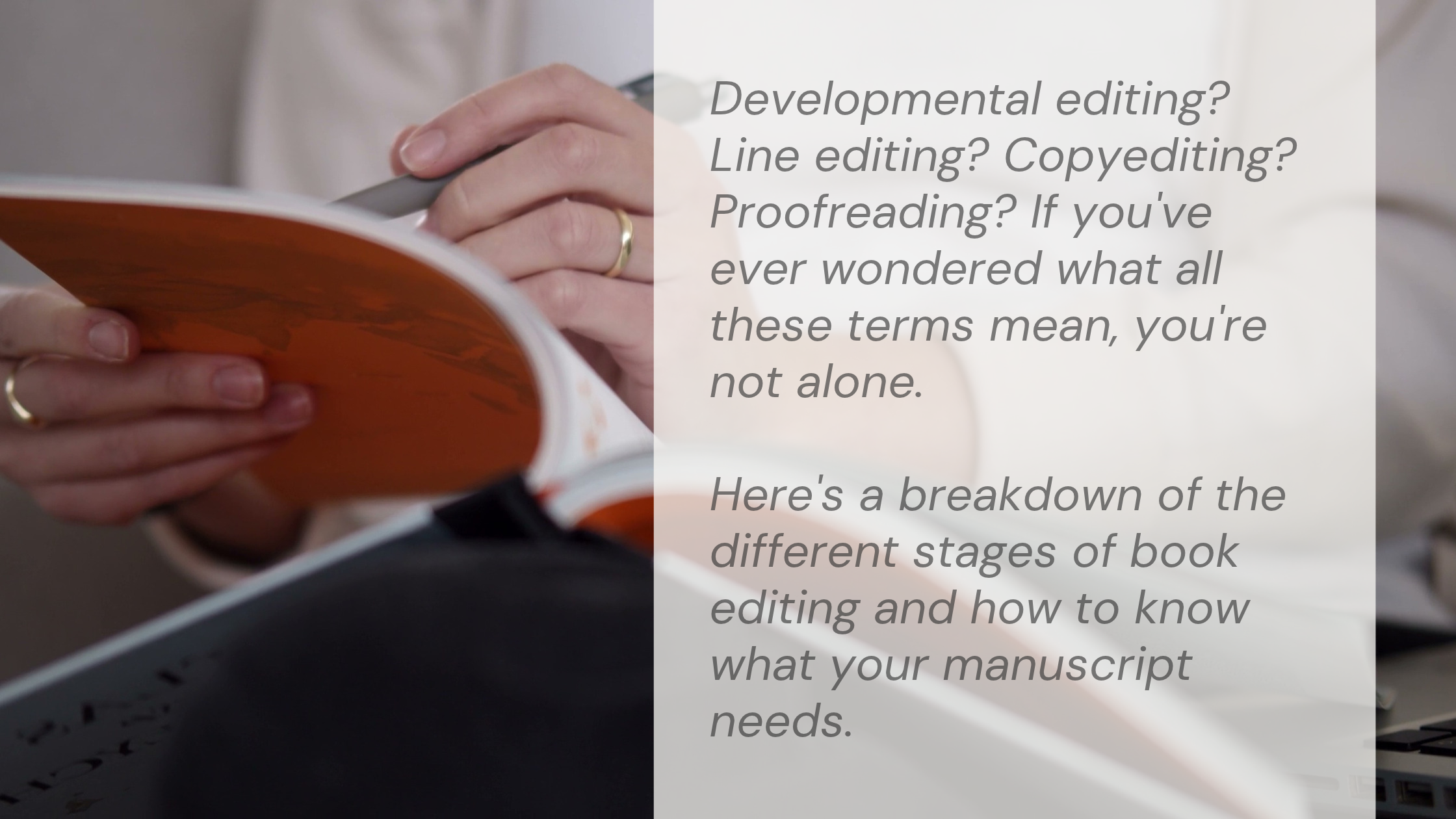
If you're writing a book, you've probably come across terms like developmental editing, line editing, copyediting, and proofreading. And if you're anything like many first-time authors, you might be wondering what all those terms actually mean. Isn't editing just editing? Not quite!
There are several stages of book editing, and each one has a different purpose. Some focus on the big-picture elements of your manuscript, while others look more closely at individual sentences, grammar, and punctuation. Understanding the differences can help you figure out what your manuscript needs and what to expect when you start working with an editor. But don't worry. You don't need to become an editing expert before hiring one. That's part of what we're here for!
Let's break down the different stages of book editing and how each one helps bring your manuscript closer to publication.
1. Developmental Editing: Looking at the Big Picture
Before worrying about commas, word choice, or sentence structure, it's important to make sure the bigger pieces of your book are in place. That's where developmental editing comes in.
Think of developmental editing as taking a step back and looking at your manuscript as a whole. Does everything fit together? Are your ideas presented in a logical order? Does each chapter serve a purpose? Are there places where readers might need a little more information?
A developmental editor looks at the overall structure, organization, and content of your book. They're not focused on fixing individual sentences just yet. Instead, they're looking for ways to make the manuscript stronger and more effective.
Why is developmental editing important for nonfiction authors?
Nonfiction books often contain a lot of information. You might be sharing years of experience, teaching readers something new, or helping them work through a particular challenge. You know your subject inside and out, but your readers are coming to it with a different level of knowledge.
What seems obvious to you might need more explanation for someone encountering the topic for the first time. Or perhaps you have so many great ideas that it's difficult to decide which ones belong where. Developmental editing helps bring everything together so your readers can follow along without feeling lost or overwhelmed.
When do you need developmental editing?
You might benefit from developmental editing if your manuscript feels disorganized, lacks a clear direction, repeats ideas, or has sections that need more development. It's often helpful earlier in the editing process, before spending time polishing sentences that might eventually need to be moved, revised, or removed.
2. Line Editing: Making Your Writing Shine
Once the overall structure and content are in good shape, it's time to focus on the writing itself. This is where line editing comes in. Line editing looks at how you're communicating your ideas, one sentence at a time. It's about making sure your writing is clear, natural, and engaging while still sounding like you.
You might have a sentence that's technically correct but feels a little clunky. Maybe an explanation is longer than it needs to be, or a paragraph doesn't quite flow into the next one. A line editor notices those things and helps smooth them out.
What does line editing include?
A line editor may focus on:
Sentence structure and flow.
Word choice and clarity.
Awkward or confusing phrasing.
Tone and consistency of voice.
Wordiness and unnecessary repetition.
Transitions between sentences and paragraphs.
Readability and engagement.
Why is line editing important for nonfiction authors?
You want your readers to understand what you're saying without having to read the same sentence three times. This is especially important when you're explaining complex ideas, sharing personal experiences, or teaching readers something new. Line editing helps make your writing easier to follow and more enjoyable to read. It can turn a wordy explanation into something more direct or help a confusing paragraph communicate exactly what you intended.
And here's something important: line editing isn't about making your writing sound like someone else's. Your voice is part of what makes your book yours. A good editor works to strengthen that voice, not replace it.
When do you need line editing?
Line editing may be right for you if your content is in place but your writing needs some refinement. Perhaps your sentences feel awkward, your explanations are wordier than you'd like, or you want your ideas to come across more naturally.
3. Copyediting: Getting the Details Right
Now that your manuscript's structure and writing have been refined, it's time to pay attention to the smaller details. Copyediting is probably what most people think of when they hear the word editing. It involves checking grammar, spelling, punctuation, and word usage. But there's more to it than simply catching typos.
A copyeditor also looks for consistency throughout your manuscript. Are names spelled the same way each time? Are important terms used consistently? Does the punctuation follow a consistent style? These details might seem small, but they make a big difference in how polished your book feels.
What does copyediting include?
A copyeditor typically looks at:
Grammar, spelling, and punctuation.
Sentence mechanics and word usage.
Consistency in capitalization and hyphenation.
Consistent terminology and formatting.
Repeated words and phrases.
Internal consistency, including names, dates, and references.
Potential factual inconsistencies that may need the author's attention.
Why is copyediting important for nonfiction authors?
When someone picks up your nonfiction book, they're trusting you to provide information they can understand and rely on. Whether you're writing about business, personal development, history, or another subject, errors and inconsistencies can distract readers from what you're trying to say.
Imagine reading a book where an important term is spelled three different ways or a person's name changes throughout the manuscript. Even small mistakes can take readers out of the experience. Copyediting helps catch those issues so your book feels consistent, polished, and professional.
When do you need copyediting?
Copyediting is usually a good next step when your manuscript is complete, the structure is in place, and you're happy with the content. It's time to make sure the technical details are as strong as the ideas themselves.
4. Proofreading: The Final Look Before Publication
You're almost there! Your manuscript has been revised, your sentences have been polished, and the technical errors have been addressed. Now it's time for one final review before your book makes its way into the world. That's where proofreading comes in.
Proofreading is the last quality check before publication. It typically happens after your manuscript has been edited and formatted into its final book layout. While copyediting focuses primarily on the text, proofreading also looks at how everything appears on the page.
What does proofreading include?
A proofreader typically checks for:
Remaining spelling and punctuation errors.
Minor grammatical mistakes.
Missing or duplicated words.
Formatting inconsistencies.
Incorrect page numbers and headings.
Spacing and layout issues.
Problems with the final formatted pages.
Why is proofreading important?
Even after multiple rounds of editing, small mistakes can slip through. It happens! Formatting can also introduce new issues, such as awkward page breaks, inconsistent spacing, or misplaced text.
Proofreading gives your book one last set of fresh eyes before publication. It's a chance to catch those little things that might otherwise make it into the finished book.
When do you need proofreading?
Proofreading is typically the final step, once your manuscript has been edited and formatted and is nearly ready to publish. One thing to remember: proofreading is not a substitute for copyediting. If your manuscript still needs significant revisions, proofreading alone won't address those issues.
5. How Do the Different Stages of Editing Work Together?
Now that we've looked at each stage individually, let's put everything together. Although every manuscript is different, the editing process generally moves from bigger-picture revisions to smaller, more detailed corrections.
Here's a quick look at how the stages typically fit together:
Developmental editing: Strengthens the structure, organization, and overall message of your book.
Line editing: Improves sentence structure, clarity, flow, and readability while preserving your voice.
Copyediting: Corrects grammar, spelling, punctuation, and inconsistencies.
Proofreading: Catches remaining errors and formatting issues before publication.
Think of it as building a house. You wouldn't spend time painting the walls before making sure the foundation and structure are sound. In much the same way, it makes sense to address the bigger issues in your manuscript before focusing on the smallest details.
It's also worth mentioning that not every book needs all four stages. Some manuscripts may need significant structural work before they're ready for sentence-level editing. Others might already be in great shape and only need copyediting and proofreading. Line editing and copyediting can also overlap, depending on the editor and the services being provided.
The goal isn't to pay for every possible editing service. It's to find the right level of support for your particular manuscript.
6. Which Type of Editing Does Your Book Need?
If you're still not sure where your manuscript fits into all of this, you're not alone. It can be difficult to look at your own writing and know exactly what needs attention. After all, you've spent so much time with your manuscript that you might not notice the things a fresh set of eyes would catch.
As a starting point, consider the following:
| If your manuscript... | You may need... |
|---|---|
| Needs better structure or organization | Developmental editing |
| Has awkward sentences or unclear ideas | Line editing |
| Needs grammar and consistency corrections | Copyediting |
| Is formatted and nearly ready to publish | Proofreading |
Of course, these aren't strict rules. Your manuscript might need a combination of services, or you might discover that you're further along in the process than you thought. If you're unsure, an editor can help you assess your manuscript and determine which type of editing would be most beneficial.
7. How Do You Know When Your Manuscript Is Ready for an Editor?
This is one of the questions I hear from authors, and I think it's worth addressing. Many writers feel like they need to have everything figured out before they reach out to an editor. They worry their manuscript isn't polished enough or that they'll be judged for the mistakes they've missed. Let me put your mind at ease: Your manuscript doesn't have to be perfect before you hire an editor.
Really!
You don't need to catch every typo, rewrite every awkward sentence, or spend weeks trying to make every chapter flawless. That's what the editing process is for.
That said, there are a few things you can do to prepare your manuscript:
Finish your draft. Ideally, your manuscript should be complete before beginning a full editing project, unless you've arranged for feedback on an individual section.
Give it a read-through. Take some time to review your work and make any changes you've already identified.
Think about your reader. Consider who you're writing for and what you want them to take away from your book.
Identify your concerns. Are there chapters you're unsure about? Sections that feel repetitive? Areas where you'd like extra feedback? Share those with your editor.
Be open to feedback. Editing is a collaborative process. Being willing to consider suggestions can make a big difference in the final result.
You don't need to have a perfect manuscript. You just need to be ready to take the next step.
The Right Editing Helps Your Ideas Shine
Writing a book is a big accomplishment. By the time you reach the editing stage, you've likely spent a lot of valuable time developing your ideas and turning them into something you're ready to share.
Understanding the different stages of editing can help you feel more confident about what comes next. Whether your manuscript needs help with structure, sentence-level clarity, grammar, or those final formatting details, each stage plays a role in helping your book reach its full potential. And remember, editing isn't about changing your ideas or taking away the voice that makes your book yours. It's about helping you communicate those ideas as clearly and effectively as possible.
Ready to take the next step with your manuscript?
At Alicia Russell Editing, I work with nonfiction authors to help their ideas shine through clear, engaging, and polished writing while preserving the unique voice behind their work.
If you're not sure what type of editing your book needs, I'd love to help you figure it out.