How to Make Nonfiction Writing More Engaging: 7 Ways to Keep Readers Turning the Pages
Great nonfiction doesn't just inform readers. It makes them want to keep reading.
Your reader may have picked up your book because they want to learn something, solve a problem, understand an idea, or be inspired. But that doesn't mean they want to read a textbook.
The most engaging nonfiction gives readers a reason to care about the information. It uses stories and examples to bring ideas to life, speaks directly to a specific audience, and allows the author's personality to shine through.
So how do you make your nonfiction writing more engaging?
1. Start With Why Your Reader Should Care
Instead of opening with everything you know about a subject, start with what your reader needs to know. The beginning of your book plays an important role in convincing readers that the rest of the book is worth their time. Show readers why they should keep reading and what they'll gain from your expertise.
Keep these questions in mind when building a solid introduction to your nonfiction manuscript:
What problem are you helping them solve?
What question are you answering?
What transformation are you offering?
Why does this information matter now?
Example:
❌ “There are many different factors that contribute to workplace burnout.”
✅ “You don't have to dread Monday morning to be experiencing burnout.”
The second immediately creates curiosity and relevance.
2. Use Stories to Bring Information to Life
Stories aren't just for memoirs or narrative nonfiction. They can make almost any nonfiction topic more memorable. Yes–even in business, leadership, personal development, and educational books! Stories can make abstract information easier to understand and give readers something concrete to remember. So, don't just tell readers what something means. Whenever possible, show them what it looks like in real life.
Types of stories you can use in nonfiction:
Personal anecdotes
Client or customer stories
Case studies
Historical examples
Before-and-after scenarios
Short illustrative stories
Example:
Information-only approach:
Sleep plays an important role in physical and mental health. Getting enough sleep can improve concentration, memory, mood, and overall well-being. Adults generally need seven to nine hours of sleep each night.
Accurate? Yes.
Engaging? Not particularly.
Story-driven approach:
By 2 p.m., Sarah had already reread the same email three times. She couldn't remember why she'd walked into the kitchen, and during her morning meeting, she'd completely lost her train of thought halfway through a sentence. She'd been telling herself she was simply having a busy week.
In reality, she'd been sleeping five hours a night for the past month.
Sleep isn't just downtime. It's when the brain processes information, consolidates memories, and helps regulate mood. When we consistently cut that time short, we can feel the effects long before we realize what's causing them.
The information hasn't changed dramatically. But now the reader has a person, a situation, and a problem they can recognize.
3. Write for One Reader, Not “Everyone”
Writing for everyone often results in writing that feels like it's for no one. When you picture one specific reader, you can address their questions, concerns, and goals directly. Before you start writing, imagine your ideal reader sitting across from you. What would they ask? What are they struggling with? What do they need to hear? Write to that person.
When defining your target reader, consider:
Their knowledge level
Their concerns
Their questions
Their goals
Their frustrations
Example:
Writing for everyone:
Walking is a simple and effective form of exercise that can provide many health benefits. Regular walking can improve cardiovascular health, increase physical activity levels, and support overall well-being. People should aim to incorporate walking into their daily routines whenever possible.
It's not wrong, but it's generic. It could be written for anyone.
Writing for one specific reader:
Imagine your reader is a 45-year-old office worker who sits most of the day, feels out of shape, and wants to become more active but doesn't have time for the gym.
You don't need an hour at the gym to start moving more. If you spend most of your workday sitting at a desk, start with something much simpler: take a 10-minute walk after lunch. Leave your phone at your desk, step outside, and walk around the block. Ten minutes might not feel like much, but it's a manageable place to start and something you can actually fit into a busy workday.
4. Replace Generalities With Specifics
Specific writing in nonfiction books builds trust, makes abstract ideas real, and keeps readers engaged. Vague language can make your writing feel less credible and harder to visualize. This tip really goes hand-in-hand with writing tip 3 because generalities are more likely to appear when you attempt to write for everyone. When cleaning up any generalities that may have made it into your manuscript, think about your target reader. What do they already know about this? What details do they need to know and are important to them?
Look at replacing these words with something more specific:
Things
Stuff
Many
Often
Better
Successful
Effective
Important
Example:
❌ “Making small changes to your routine can improve your productivity.”
✅ “Moving your phone out of reach during your first hour of work can eliminate dozens of small distractions before your day gets started.”
5. Give Your Reader Reasons to Keep Turning the Page
One thing that defines a really good nonfiction book? Forward momentum. A sense of progression (even in informational books) keeps readers engaged. It may look different depending on your genre, but every nonfiction book can create forward momentum. Every section doesn't need a cliffhanger, but your reader should have a reason to keep going. Think of each section as answering one question while opening the door to the next.
Ways to create momentum:
Raise a question and answer it later
Preview what's coming
End sections with an unexpected insight
Build from simple concepts to more complex ones
Create a clear progression toward a transformation
Example
Without forward momentum:
Procrastination is common and can have a negative impact on productivity. There are many reasons people procrastinate, including fear of failure, perfectionism, lack of motivation, and feeling overwhelmed. Understanding the reasons behind procrastination can help you develop strategies to overcome it.
The information is useful, but the reader has little reason to continue.
With forward momentum:
You know that project you've been putting off? The one you've promised yourself you'll start tomorrow?
You might think the problem is a lack of motivation. But what if motivation isn't the problem at all?
In the next chapter, we'll look at the hidden reason many people procrastinate—and why simply telling yourself to “try harder” rarely works.
Now the reader has a question they want answered: If motivation isn't the problem, then what is?
That's the pull that encourages them to keep reading.
6. Make Complex Ideas Easier to Understand
Being knowledgeable doesn't mean you have to sound complicated. Your job isn't to impress readers with how much you know; it's to help them understand and use what you know. The key is to simplify without oversimplifying. Let your target reader guide the level of detail, terminology, and explanation you use. And remember: Simple writing isn't simplistic writing. Your goal isn't to remove complexity from the subject. It's to make that complexity easier for your reader to understand.
To simplify complex ideas, consider using:
Plain language
Analogies
Examples
Breaking concepts into manageable pieces
Avoiding unnecessary jargon
Explaining unfamiliar terminology
Example:
The complicated version:
Compound interest is the process by which interest earned on a principal amount is reinvested and subsequently earns additional interest. Over time, the accumulation of interest on both the original principal and previously accumulated interest results in exponential growth.
Accurate, but it makes the reader work.
The reader-friendly version:
Think of compound interest like a snowball rolling downhill. At first, the snowball grows slowly. But as it rolls, it picks up more snow–and that larger snowball picks up even more with each turn.
Your money can work the same way. You earn interest on the money you originally invested, but then you also earn interest on the interest you've already accumulated. The longer your money has to grow, the more dramatic the effect can become.
7. Let Your Personality Into the Writing
Many nonfiction authors become overly formal because they think they need to sound “professional” or authoritative. However, readers connect with people, not just information. Don't be afraid to let your natural voice come through. A little humor, an opinion, a personal observation, or even a phrase you'd actually say out loud can make your writing feel more authentic. You don't have to choose between sounding professional and sounding like yourself. Great nonfiction can (and should) do both!
I encourage nonfiction authors to:
Use natural language
Share opinions when appropriate
Use humor when it fits their voice and subject
Use contractions when appropriate
Write the way they actually speak
Avoid forcing a “professional” voice that doesn't sound like them
Example:
Without personality:
Setting boundaries is an important part of maintaining healthy relationships. Boundaries communicate your needs and expectations to others and can help prevent feelings of resentment. It is important to communicate boundaries clearly and respectfully.
The advice is sound, but it could have been written by almost anyone.
With personality:
Let’s be honest: saying “no” can feel incredibly uncomfortable. You might worry that someone will be disappointed, think you’re being difficult, or (my personal favorite) decide that you’re suddenly a terrible person.
But setting a boundary doesn't make you selfish. It tells people what you can (and can't) take on. And the sooner you get comfortable saying “I can't do that,” the less likely you are to find yourself quietly fuming while doing the very thing you didn't want to do in the first place.
Make Your Nonfiction Impossible to Ignore
Great nonfiction does more than deliver information. It makes readers care about that information.
As you write, look beyond what you want to tell your reader and consider what will make them want to keep going. Use stories to bring ideas to life. Write directly to your ideal reader. Replace vague language with specific details. Create momentum from one section to the next. Make complex ideas easier to understand, and don't be afraid to let your personality come through.
Your expertise is what brings readers to your book. Your writing is what keeps them there.
And if you've finished your manuscript but aren't sure whether your ideas are coming through as clearly and compellingly as they could, that's where a professional editor can help. A fresh perspective can identify places where readers may become confused, lose interest, or need more context and help you strengthen those areas while preserving your unique voice.
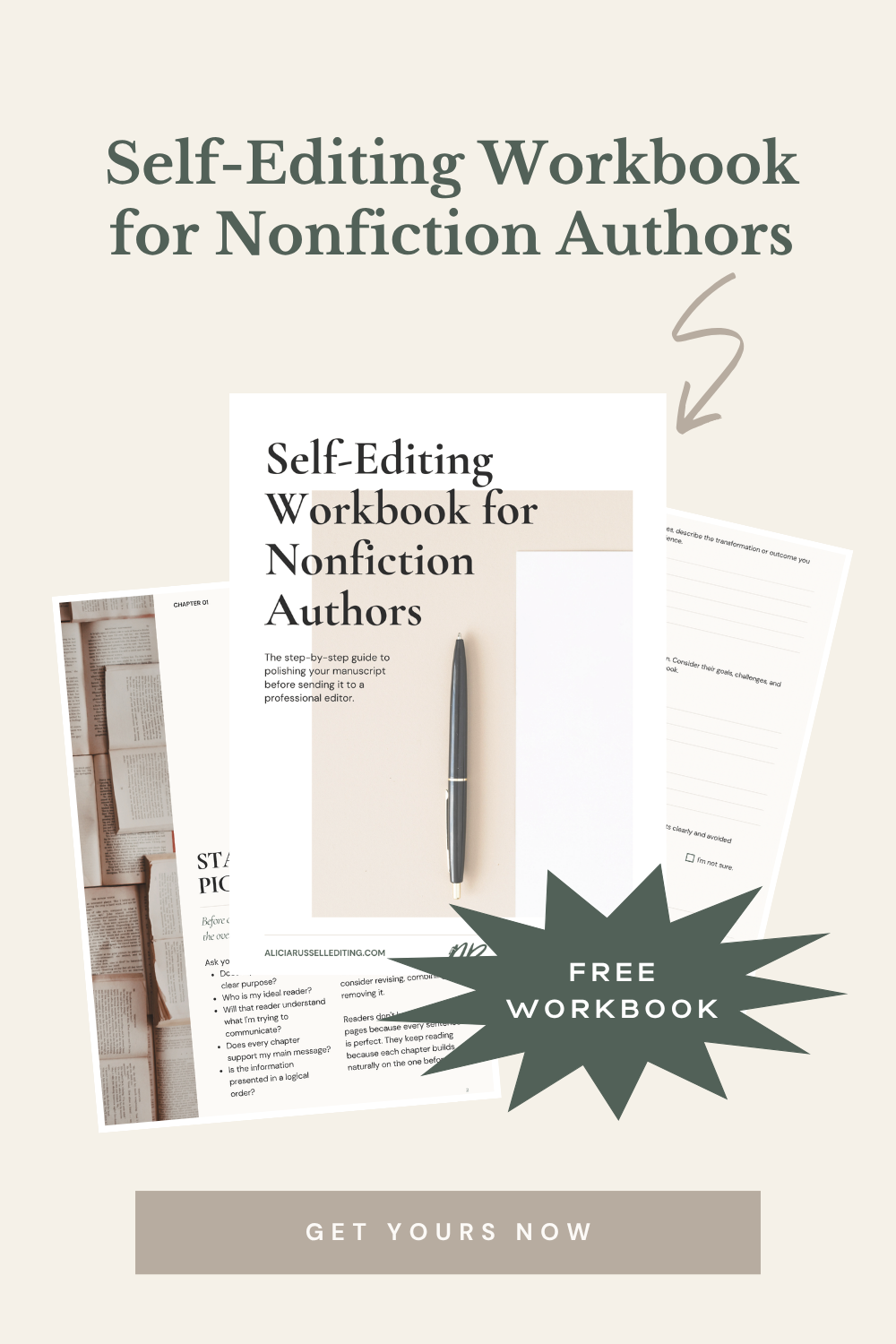
Ready to Strengthen Your Manuscript?
If you're preparing your nonfiction book for professional editing, I've created a free resource to help you through the process.
Download my free Self-Editing Workbook for Nonfiction Authors to learn what to review before sending your manuscript to an editor.
Inside, you'll find practical checklists, guided worksheets, and editor tips to help you polish your manuscript with confidence.
Whether you're writing your first book or your fifth, this guide will help you take the next step toward a stronger, more polished manuscript.